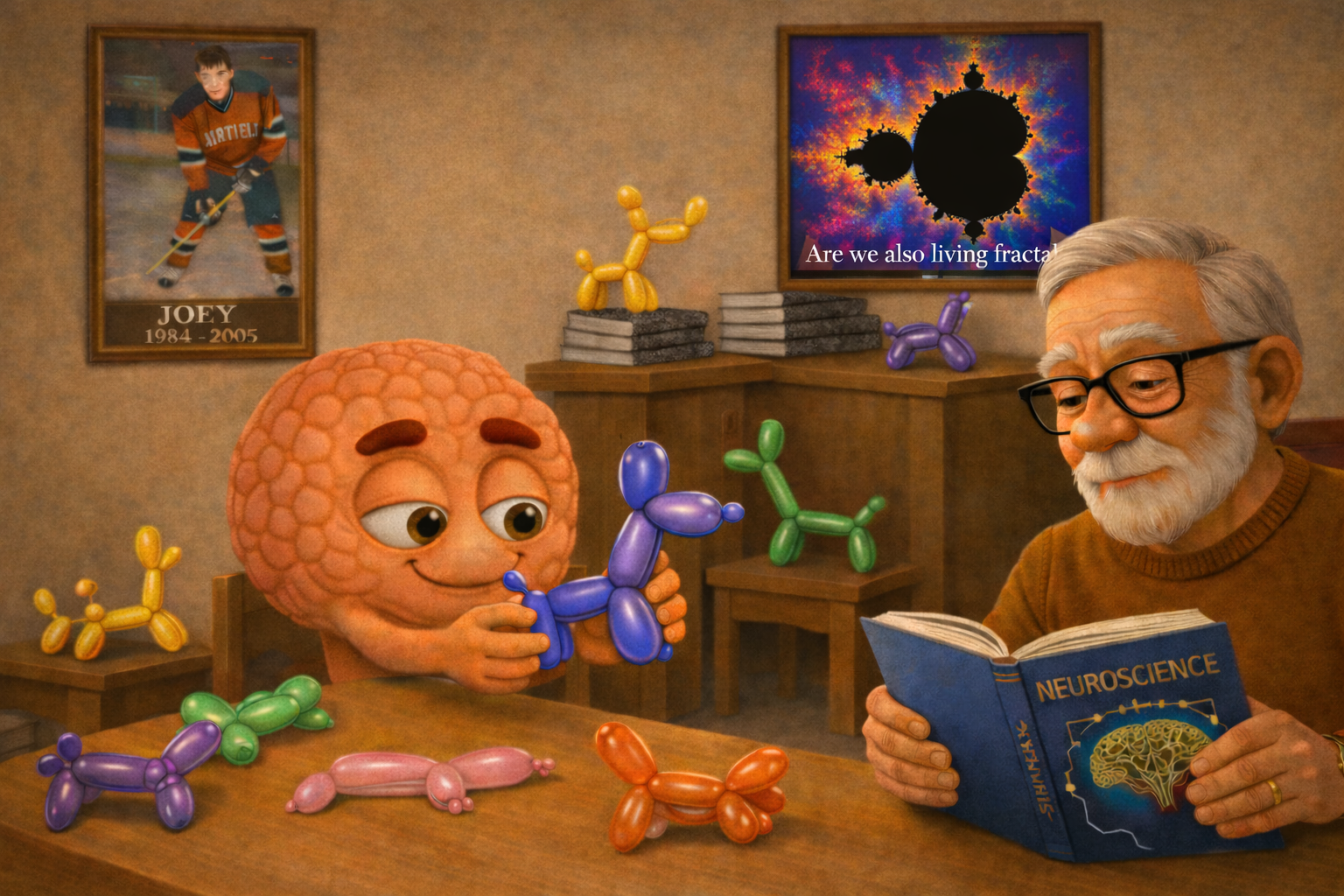
Balloon Animals
We Are All Living Balloon Animals
Force, Electron Clouds, and the Squishy Secret of Strength
Early one morning, before I was even up for the day, a question I've carried for twenty years suddenly felt new: What is a mechanical force, really?
Not the textbook answer. Not F = ma. The actual, physical thing — what happens between atoms when a steel beam carries a load, or when you push your hand against a table, or when a seventeen-year-old ironworker walks backward across a warped plank over an open elevator shaft carrying one end of an I-beam.
That last one isn't hypothetical. That was me.
I chased the question the way I chase most things — by talking it through, sketching ideas, following threads until something clicked. And what clicked surprised me enough that I turned it into a 45-minute audiobook essay for my Mechanics of Materials students.
The short version: every contact force you've ever felt in your life is, at bottom, electron clouds resisting distortion. The floor pushing back against your feet right now? Electrons repelling electrons. The tension in a guitar string? Electrons holding onto electrons. When you stretch a material and it contracts sideways — Poisson's ratio — what's actually happening is that the three-dimensional network of atomic bonds couples the directions together, like pulling on a fishing net. Stretch it one way, the mesh contracts the other. And the electron clouds at every bond resist being reshaped, because moving them away from their lowest-energy configuration costs work. Real force through real distance.
That's when the image hit me: imagine a spherical balloon. Squeeze the sides. The top and bottom bulge out. You feel the resistance. The air inside pushes back.
That balloon is the electron cloud.
And if you scale that picture up — from a single atom to a crystal lattice to a bone to a muscle fiber to a camera spring cycling millions of times under vibration testing — you arrive at something that made me laugh out loud at six in the morning:
We are all living balloon animals.
Every step, every breath, every flex of your arm — trillions of tiny, squishy, electron-filled balloons being squeezed and stretched and twisted. They resist. They store energy. They talk to each other across every dimension. And when they've been twisted one too many times, they crack.
That's not a metaphor. That's materials science.
The full audiobook essay walks through all of this — Poisson's ratio built from a fishing net analogy, the atom-count question most students never think to ask, why true stress exceeds engineering stress at the atomic level, the brittle-ductile spectrum and why those labels are human constructs imposed on a continuous reality, and a near-miss story involving a warped plank, compression-damaged wood fibers, and the same failure mechanism that tore wings off World War Two gliders.
The content is mine — two decades of classroom demonstrations, stories, and ways of seeing refined at the whiteboard. I partnered with AI (Grok and Claude) to organize my teachings into spoken-word form. The AI didn't create the content. It couldn't. It doesn't know why I hand every student a physical copy of J.E. Gordon's book. It doesn't know what it feels like to walk backward over a shaft on a bowed plank. I brought the thinking. AI helped me structure it.
Drivers, not passengers. That's how this was made, and that's what I teach.
Listen to the full audiobook essay →
Read the full written script →
Joseph P. McFadden Sr. teaches Mechanics of Materials and has been an engineering educator for over twenty years. His audiobook essays are developed from actual classroom content and made available to students as a supplementary learning channel — because when the brain receives information through multiple senses, it signals that the content matters.