
What Every Engineer Should Know About FEA
Part 1 — The Ask, the Model, and Your Role as a Partner Part 1 establishes the foundation — what a drop simulation actually is, why you asked for it, and what it can and cannot tell you. We introduce the idea that the simulation is a model, not the truth, and that the engineer who commissioned the work is not a passive recipient of results but an essential partner in making them meaningful. The INP Comprehensive Analyzer at McFaddenCAE.com gives you a way to go further — to look inside the model yourself, check the materials, inspect the interactions, and see how the pieces of your system actually connect. Because it is your system.
Link for audiobook → https://www.dropbox.com/scl/fi/oyd317ryl3qc2fhx387qk/Part_1_What_Every_Engineer_Should_Know_About_FEA_McFadden_19March2026.mp3?rlkey=txir9vaiin87gayzzmtd3ys48&st=2p8ey8ud&dl=0

You Already Know How to Think About the Inputs
Part 2 — What Goes Into the Model Part 2 opens the door to the model itself — not to make you an analyst, but to show you how the choices made in building it directly affect what it can tell you. We walk through geometry and simplification, mesh density, material properties and rate-dependent behavior, drop conditions, and contact. Along the way we introduce Silly Putty — not as a gimmick but as a lesson — because feeling rate dependence in your hands is worth more than reading about it on a slide. At every stage, your knowledge of the real product is identified as essential input that no CAD file can fully provide.
Link for audiobook → https://www.dropbox.com/scl/fi/yqzq2uot3pxxpuyidxnsk/Part_2_What_Every_Engineer_Should_Know_About_FEA_McFadden_19March2026.mp3?rlkey=n2whepu5gpb4iqbg24uagwgkc&st=7got4ik6&dl=0

From Numbers to Meaning
Part 3 — Reading the Results Part 3 is where the technical depth lives — and where the partnership between engineer and analyst matters most. We cover what Von Mises stress actually is and the one critical thing it cannot tell you, why yielding is a shear-driven event and not a hydrostatic one, what stress is at the atomic level, and why you should never use Von Mises for brittle materials or any material with elongation at break below five percent. We discuss glass failure through the lens of Weibull statistics and the B10 criterion — because glass strength comes from its flaws, which are random, and designing to a survival rate rather than a stress limit is the honest truth of how that problem works. We close with the idea that simulation is virtual prototyping, not a replacement for testing, and that the brain itself has been building and updating predictive models your entire life. CAE follows exactly the same path.
Link for audiobook → https://www.dropbox.com/scl/fi/nd5of8us21qoeyyt713a6/Part_3_What_Every_Engineer_Should_Know_About_FEA_McFadden_19March2026.mp3?rlkey=xk2lmwml7rynetpgau2hyrcxx&st=kicnkzis&dl=0
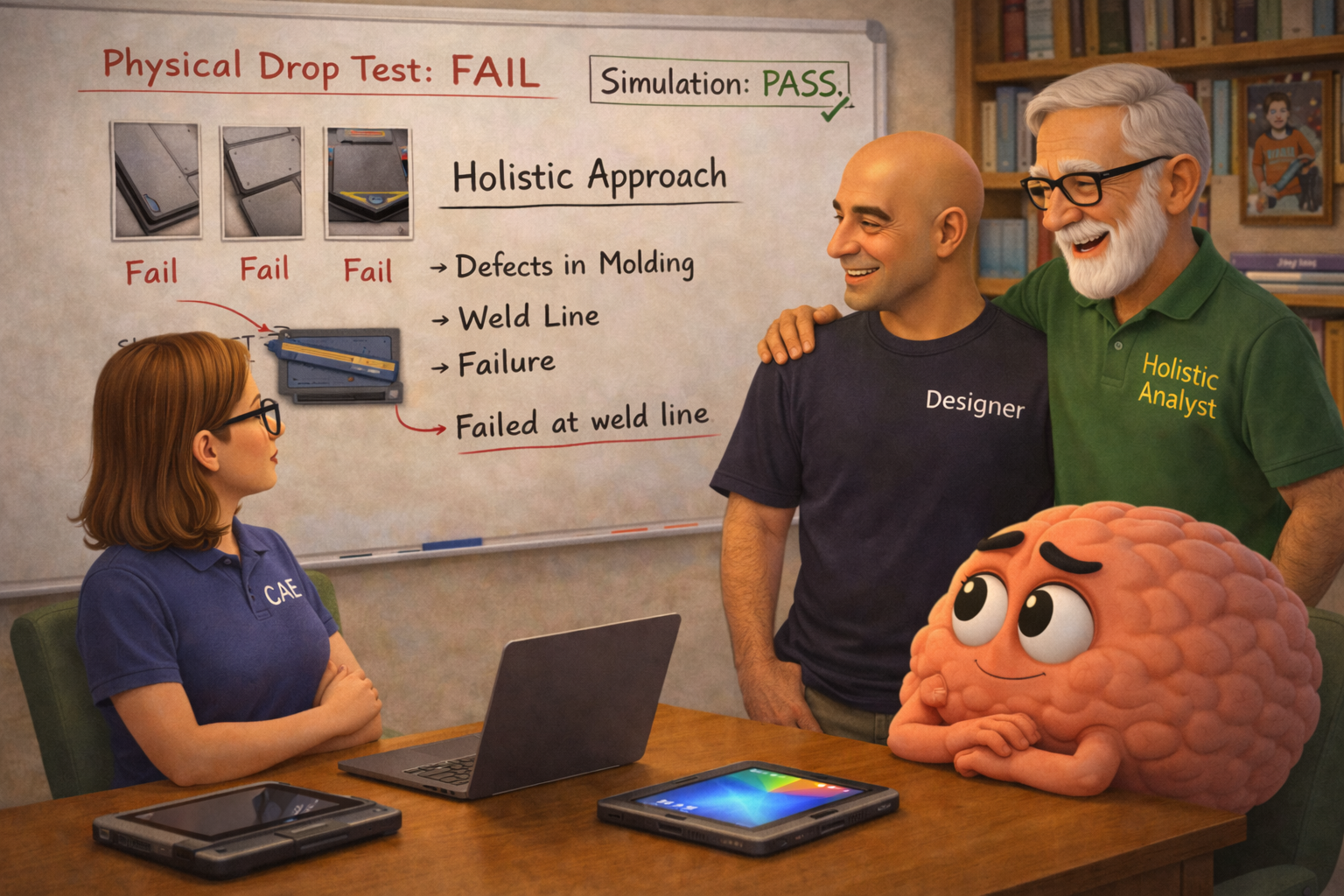
The Gap Is Always There
Part 4 — The Gap Between Model and Reality Part 4 names what is too often left unsaid in a simulation review: there is always a gap between what the model predicts and what the physical product does. Always. The question is never whether the gap exists but where it is largest, what is driving it, and what it means for the confidence you should place in the results. We walk through five specific sources — geometry and manufacturing variation, material database versus production material, contact approximation, drop event variability, and unmodeled features — and close with the most important conversation in any results review: the comparison between what the simulation predicted and what the physical test revealed. That correlation is what calibrated confidence is built from.
Link for audiobook → https://www.dropbox.com/scl/fi/kugmx3e17jgqyct373m0l/Part_4_What_Every_Engineer_Should_Know_About_FEA_McFadden_19March2026.mp3?rlkey=0xp2ki7ln8sxi1h9h7yb27o6i&st=jx3togit&dl=0
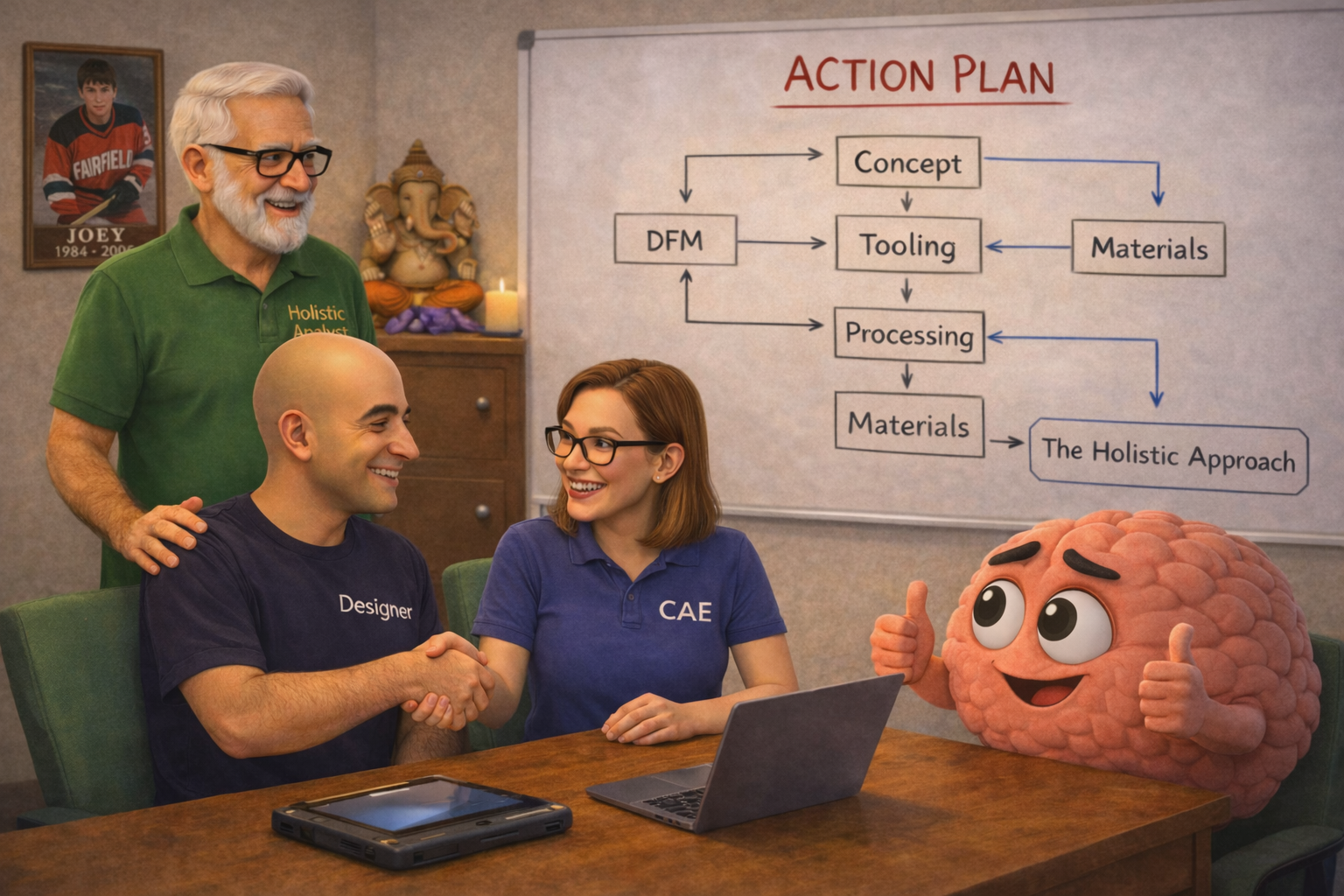
The Moment of Translation
Part 5 — Using the Results to Drive Design Decisions Part 5 is the payoff. The model has been built, the results have been read, and the gap has been understood. Now comes the question everything else was preparation for: how do you take what the simulation is telling you and use it to make a better design? We walk through how to read results as a map rather than a verdict, how to trace the load path before you look at stress values, how to ask the right what-if questions, and how to know when the simulation has told you what it can tell you and the right next step is to decide rather than analyze. The series closes with a five-point summary to carry forward and a final statement of the partnership: the analyst has the method, you have the system, and together you have the answer.
Link for audiobook → https://www.dropbox.com/scl/fi/30lmq1scz7bipadb3f0ns/Part_5_What_Every_Engineer_Should_Know_About_FEA_McFadden_19March2026.mp3?rlkey=u5kmxvcb48tnakjnq3zrnilz2&st=okni3x0q&dl=0